Blog

Tim’s tips – April 2016

Tims tipsTOADS CROSSING

The starter activity at our recent Observer’s Training Evening was to challenge observers to name the creatures which feature on triangular warning signs. (How many of the six creatures in Know your traffic signs, pages 14-15, can you name?)

One example is the migratory toads crossing sign. I didn’t realise that local councils only display this sign at appropriate times of the year (thanks to Martin for that). So I went home and did some research.

The European Common Toad is found throughout the country, while the Natterjack is found in north-west and southern England. Common toads are very particular about where they breed and often migrate back to their ancestral breeding ponds each year. They follow the same route, regardless of what gets in their way, which sometimes leads to them crossing roads.road scene

Global warming has led to a change in their breeding and migrating patterns and this forced the Department for Transport into a rethink on the rules which govern temporary road signs. As the law stood before 2009, councils could only put up ‘migratory toad crossing’ signs between February and May.

Because of changes in our climate, toads are breeding and migrating earlier in the year. So the DfT announced in 2009 that these signs will go up in January, giving the toad – officially a ‘biodiversity priority species’ – an extra month’s protection.

It is estimated that there are around eight million toads in Britain, rather fewer than there were just after the Second World War. It’s also estimated that 20 tonnes of toads are killed on the UK’s roads every year.

In a Telegraph article Edmund King, the AA’s President said: ‘To be honest I have always wondered what drivers are supposed to do if they see amphibians in the road in front of them.’ Amphibian and Reptile Conservation advise the following:

  • Slow down carefully and, if possible, drive safely around toads. (I’d never thought of that.)
  • Note your location, the approximate number of creatures and, if possible, the direction the toads are moving and report this to Amphibian and Reptile Conservation – they map (through Google Earth) where crossings occur, support the process of sign erection and in some places help coordinate volunteer ‘Toad Patrols’.

For more information including details on migratory toad crossings near you see froglife.org.

FOLLOW MY LEADER, OR SEE MY WAY?

My daily commute is a pleasant rural drive, but it coincides with school buses taking students to and from towns in the High Peak.

When I was a child and travelled to school by bus, we purchased bus passes. This allowed us to board quickly so the bus held up the traffic only briefly, even when collecting a full load. I have noticed that the school buses I follow now take for ever to pick up their passengers. With only one child boarding I would expect the bus to be away promptly. But no. We sit. And wait.

I’ve no idea why boarding takes so long but there is a consequence.

Motorists get impatient and overtake the bus, blindly following one another without any regard to oncoming traffic. It can be difficult to see if there is an oncoming vehicle (the yellow car in my graphic) especially if one of the overtaking vehicles is a van. Even so, drivers just plough on regardless and oncoming traffic is confronted and has to give way.

If you hold back behind the bus to check if it is safe to overtake rather than following the procession, traffic following you is likely to get impatient. Even so, this is what I usually do If I can’t see. I won’t cross the centre line unless I can see it is safe to do so.

Do you know why the bus drivers take so long to pick up their passengers? Do write in and tell me….
Tim’s tips – January 2016

Same old story…. I have just read a leaflet pushed through my front door by a local political party. One item caught my attention. The party in question want to reduce a short section of the A6 from 40 to 30 mph and reduce the speed limit in a housing estate to 20 mph.

I’m not bothered about the 20 limit because one can hardly do more than that there anyway. But the 40 mph section of the A6 is perfectly safe and gives motorists a chance to relieve the tedium of the endless 30 mph sections (which used to be 40 mph until they were further restricted).

They have not secured my vote!

The leaflet arrived at the same time as a friend lent me a book containing reprints from Car magazine originally published in February 1966. An article that caught my eye was written by Stirling Moss and titled:

‘It’s the limit, 70. Don’t just stand there. Let’s get together and act. Now.’

He was responding to the decision by the Government of the day to make the then-temporary 70 mph national limit permanent. He wrote ‘People realise that speed is what M-roads are built for…. The realisation that others may be going faster than you are keeps you alert, keeps you out of the fast lane and on the ball.’

He blamed motorway accidents in normal weather conditions on an ‘irresponsible section of the public which can never be curbed.’ He went on, ‘I mean you can’t stop a certain percentage of criminals killing people even though they may know they’ll get hanged for it. Without an overall limit, the man who is going slowly is more inclined to keep to the left and let the faster man pass him on the right.’

He then went on to discuss the bunching effect caused by all drivers in all lanes sticking to 70 mph, usually following too closely, and the consequences of a mistake by one driver being amplified and causing a serious collision. He considered the argument that an accident at 90 mph would be more serious than one at 70 mph: his view was that cars could not withstand collisions at 90 any more than at 70, and the consequences would be much the same. (Even today they don’t test crash cars at over 40 mph.)

He continued ‘A car is only safe if it’s standing still, with the engine switched off, in a garage: as soon as you start it up you can get asphyxiated by carbon monoxide, and the moment the thing begins to move at even two miles per hour you can run somebody over. The same car does not suddenly become more dangerous as soon as it exceeds 70mph…. It depends almost entirely on what you hit and how hard you hit it.’

He went on to say that in racing you are most vulnerable to a crash when you are either leading or losing by a large margin. That is when concentration levels can be lower and errors made. The unrealistically low speed limits imposed today are causing low concentration levels and boredom, two common ingredients in a collision.

As part of his article Stirling Moss encouraged readers to cut out and send the following to Mrs Barbara Castle MP, the then Minister of Transport:

Madam,

Like Stirling Moss, I am seriously concerned at the incidental effects which the nationwide 70 mph speed limit is having on an already impossible traffic situation. As a thinking individual I doubt sincerely that the restriction, in itself, will have any beneficial effect.

With Mr Moss, I urge you to do all in your power to see that the limit is not extended as a sop to ‘public opinion.’

[The limit stayed, its effects as Stirling had predicted; 2015 was the 50th anniversary of its being made permanent. For our newer members, we will shortly re-run our 40th Anniversary article about it.]

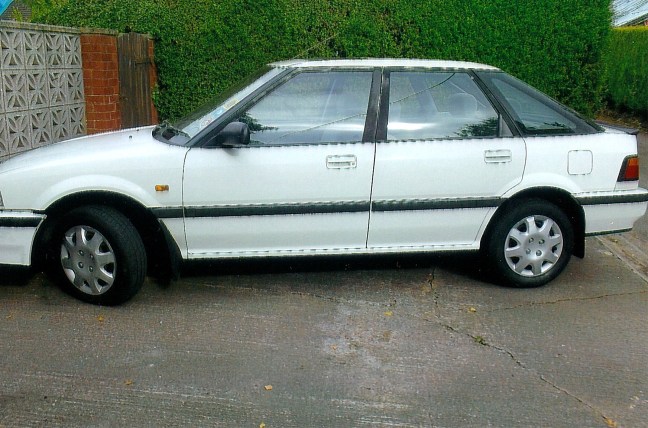
MEMBERS’ SPECIAL CARS – HILARY ADAMS: MY HONDA CONCERTO

Group member Hilary Adams wrote in mid-November:

’Some months ago you asked whether any IAM member had a special vehicle that they might like to be featured in the Congleton Newsletter.

This is my beloved Honda Concerto, which was 22 years old in August, when it once again sailed (drove?) through its MoT.IAM Hilary Adams' Honda

When I bought it for £3,000 in 2005, it had only 12,000 miles on the clock, and was in perfect condition. I asked the salesman why it was such a bargain, and he replied that its previous owner was an elderly gentleman who had it serviced meticulously, and never averaged more than 1,000 miles a year – but nobody wanted such an old-fashioned car! Now

Incidentally, it was much admired by Bob Brittain when I passed my IAM test in it three years ago, and this week I drove it successfully on a Mature Driver’s Assessment with John Hulse.’it’s coming up to 70,000, and my family think that I should downsize to a model more suited to an 88-year-old, but I love it dearly.

Thanks, Hilary, for sharing your car story with us. Many Group members must own, or have owned, a car or bike worth telling us about – something special from your early days, or a particularly high-performance model.

The Editor can think back to a 1924 Morgan Brooklands three-wheeler, complete with air-cooled side-valve v-twin; a 147 cc James Captain and a 250 cc Excelsior Talisman two-stroke-twin motor­bike; a 1936 Singer Le Mans two-seater, a bread-and-butter Ford Anglia saloon and a Triumph TR3. A Honda 90 bike was the first internal-combustion machine that he owned that did not consume or leak oil! Then came a TR4, Triumph 1300, Triumph 2000, and three P6 Rovers, a 2000TC, a 2200TC and a 2000, plus a Hillman Imp and a Renault 4. We had a VW Combi in Kenya, then back in the UK a Peugeot 205, a VW Passat estate, a Subaru Outback and his present Forester 2.0 XT, and two Kias and a Vauxhall Agila for Judy.

But he does enough writing around here already! if you have owned an interesting car or bike, old or new, or one that meant something special to you, tell us about it, please. Don’t worry if you are not a polished writer – just send Peter some notes, ideally with photos, and he will turn them into a suitable article.

New IAM uniform standards

On Wednesday 25 November we had a full house to hear Mark Lewis, IAM Director of Standards and Chief Examiner (right), and Richard Gladman, Standards Compliance Manager. They gave us a presentation on the new uniform standards that are to be introduced IAM-wide for preparing people for the Advanced Driving and Motorcycling Tests.

KONICA MINOLTA DIGITAL CAMERA

Mark began by pointing out that our examiners are drawn from local police forces, and so at present associates are tested to the standards of the force to which their examiner belongs or belonged. Each force has its own ideas, and so there is substantial variation across the country in what associates are expected to achieve on test.

Under the new standards, in future:

  • Each associate will be given an Associate Log Book which contains the full course content.
  • The observer’s rôle will be to ‘bring it to life’.
  • Each run will be recorded on a run sheet, the design of which is being compiled from inputs from IAM groups across the UK.

The outcome will be that each associate, observer and examiner will work to the same course content, and everyone will know what is required to drive with the IAM. This will make our tests more consistent. The marking guide will have three grades rather than five:

  • 3 – requires development.
  • 2 – satisfactory.
  • 1 – commended.

The ‘1’ grade signifies ‘sparkle’. The IAM needs to be able to justify its assessments. We have, for example, been asked to do so by the police. There is more information on the grades in the Standards section of the IAM website. For the first time, there will be ‘word pictures’ of what each grade represents, for each competency, on the reverse of the test sheet.

The Skill for Life course content and, in due course, revised versions of How to be a Better Driver and How to be a Better Rider will become the guides to achieving the required performance, rather than Roadcraft. They have the advantage of being ‘owned’ in-house.

Mark made it clear that there will be no change in the standard of performance and accomplishment that associates will be required to demonstrate.

‘Simply, we have written it down.’ There will be some small changes in what candidates are required to do, but the basis will be ‘If it’s in the course content, you can be tested on it; if it isn’t, you can’t.’

There will, however, be a shift in emphasis: ‘less on inputs, more on outputs’. This will ‘make it more realistic’, freeing candidates to ‘use what suits’ to achieve their objective.

That is, there will be less emphasis on using (or not using) particular techniques. Mark and Richard cited the example of steering: ‘If it’s not broken, don’t fix it.’ If a driver is controlling their car well, there is no point in trying to constrain them to do it in a different, particular way or to avoid doing something that they are doing. If something doesn’t work, then the observer should offer suggested techniques as a tip (not a rule) to help people to get it to work.

Mark described how ‘IPSGA’, the principles of car control identified as Information-Position-Speed-Gear-Acceleration, was ‘owned’ by the IAM, but was first introduced by the Metropolitan Police. In the days of heavy clutches, brakes and steering and double-declutching, the Met wanted to find a way to slow their drivers down. They asked an aristocratic racing driver to devise an orderly method of car control. He came up with IPSGA.

Originally the PSGA elements were presented as a sequence, with, for example, braking and gear-changing separated. However, Mark made clear that in modern cars with synchromesh gearboxes, which do not require double-declutching, brake-gear overlap is recognised as good practice. They were thinking of suggesting that it should be done ‘at low speed’, but were not going to declare a maximum speed: if they did, and specified, say, 25 mph, someone would ask whether an overlap at 26 mph on test was fail point!

A member of the audience suggested that there were ‘three instances’ when brake-gear overlap was legitimate. Richard responded that overlapping did not need to be ‘justified’ in terms like that: under normal circumstances it was safe and perfectly acceptable.

The IAM’s new approach will embrace awareness of issues like human factors competency: ‘Are you fit to ride or drive?’ This means not just simple medical fitness, but also your stress level, any pressures you are under, your peace of mind or anger, and so on.

Giving a coordinated commentary is a particular skill, and what might be possible at 30 mph might not be practical at 60 or 70 mph. Instead, observers and examiners will look for ‘spoken thoughts’. ‘Tell me what you are thinking’ – and the ideal response would fit the mnemonic ‘OAP’: what you Observe, what you Anticipate, and what you Plan to do. Candidates may be asked questions like ‘Where are you going to park?’ or, in a cul-de-sac, ‘Where are you going to turn round?’ The aim all the time is to make thinking drivers and riders. The basic standard remains you must be safe. Where a candidate has a disability, the IAM will exempt them from the competency concerned.

Associates will be expected to be familiar with their car or bike’s technology. Observers and examiners will not be expected to know every vehicle and machine in detail, but should ask associates what particular switches do or particular lights indicate.
Mark and Richard are each former police instructors and examiners with substantial experience of driver and rider training and checking, and their presentation was excellent – clear, concise and spiced with humour. Numbers of us will find the whole approach that Mark and his team are taking very refreshing and encouraging.  All in all, the whole evening was very valuable, and a high note on which to end our monthly meetings for the year. The pilot schemes now being run with various groups are going well, and the roll-out date for the new standards has been brought forward to 1 April 2016; in practice, there will be training sessions on different dates for each local group.


IAM Skills Day at Croft (Cars) – Tuesday 22 September

Following a cancellation of a corporate customer, we have a limited number of places available for the IAM Skills Day being held at Croft circuit, on Tuesday 22 September (am session only).

The price is just £129 and is a great opportunity to learn more about advanced driving techniques in a safe and friendly environment.

I would be grateful if you could pass this message on to your group members and anyone else who you think may be interested.  Please note that these events are open to both members and non-members of the IAM.

I have attached a link to the Skills Day page on the IAM’s website for information: http://www.iam.org.uk/drivers/motorists-courses/driving-assessment/skills-days

For further enquiries and any bookings, please call: 0300 303 1134

Very best regards,

Toby Shaw

Regional Operations Manager – Northern Region

The Institute of Advanced Motorists – IAM

Mobile: 07590775380

Email: toby.shaw@iam.org.uk

Web: www.iam.org.uk and www.iamdriveandsurvive.co.uk

Exhaust Pipes – Not me officer!

Thanks to Wirral Advanced Motorists’ and Tom Ashton, slightly edited.

A police officer pulls a driver over for speeding :

Officer:  May I see your driver’s licence?

Driver:  I don’t have one.

Officer:  May I see the registration document for this vehicle?

Driver:  It’s not my car, I stole it.

Officer:  The car is stolen?

Driver:  That’s right.  But come to think of it, I saw the owner’s registration document in the glove box when I was putting my gun in there.

Officer:  There’s a gun in the glove box?

Driver:  Yes sir, that’s where I put it after I shot the woman who owns this car and put her in the boot.

Officer:  There’s a body in the boot?

Driver:  Yes, sir.

Hearing this, the officer immediately called for back-up.  The car is quickly surrounded by police and an inspector approaches the driver to handle the tense situation:

Inspector:  Sir, can I see your driving licence?

Driver:  Sure, here it is.

It was valid.

Inspector: Who’s car is this?

Driver: It’s mine, officer.  Here’s the registration document.

It too was valid.

Inspector:  Would you slowly open your glove box, so that I can see if there’s a gun in it?

There was no gun in the glove box.

Inspector:  Would you mind opening your boot? I was told you said there’s a body in it.

Driver:  No problem.

The boot is opened and there’s no body.

Inspector:  I don’t understand it.  The officer who stopped you said you told him you didn’t have a driving licence, stole the car and had a gun in the glove box and that there was a body in the boot!

Driver:  Yes and I bet the liar told you I was speeding as well!

Dynamic Signs – Edited, and with thanks, from the Journal of Consumer Research

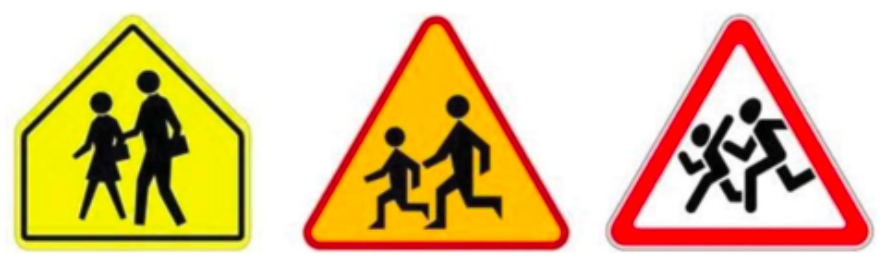
Researchers from the University of Michigan and Brigham Young University (BYU) have discovered a way to provide a little extra safety margin when it comes to near-accidents. They have found that people react significantly faster to warning signs that depict greater movement.

‘A sign that evokes more perceived movement increases the observer’s perception of risk, which in turn brings about earlier attention and earlier stopping,’ said Ryan Elder, a professor in BYU’s Marriott School of Management, and co-author of the study. ‘If you want to grab attention, you need signs that are more dynamic.’

Screen Shot 2015-08-07 at 10.26.02

Dynamic signs are those that include images appearing to move at a higher speed. For example the cross- walk sign from the US, left above, with the figures apparently showing little speed of movement, has very little dynamism. The sign in the middle, from Poland, with people running, has more, and the one on the right is highly dynamic – the figures appear to be sprinting.

‘If the figures look [as if] they’re walking, then your brain doesn’t worry about them shooting out into the road,’ Elder said, ‘But if they’re running, then you can imagine them being in front of your car in a hurry.’

In one simulator experiment, researchers found that drivers reacted an average of 50 milliseconds faster to warning signs with higher dynamism. For a car going at 60 mph, that 50 milliseconds translated into an extra 4.4 feet travelled – which could make a difference in close shaves.

Advance Warning of Speed Limits

Thanks to Group member Doug Barr for his piece commending ‘slow-down zones’ with progressively reducing speed limits before a town or village 30 mph limit. Doug also floated the idea of different speed limits on each side of the road in areas like this.

For example, coming into Macclesfield from the north on the Silk Road, there is a 30 mph limit to protect the pedestrian crossing just before the Hibel Road roundabout. This is very sensible, even though the limit is commonly more honoured in the breach than in the observance. Leaving the roundabout northwards, however, especially as the road is a dual carriageway, maintaining the 30 mph limit for the southbound protection distance before you reach the national limit signs often causes visible frustration among, and unpleasant tailgating from, following drivers. In the early days of the IAM, this would have been classed as ‘driving without due consideration for other road users.’ An immediate release to the national limit after the pedestrian crossing would make complete sense.

Doug reported that some people whom he had discussed slow-down zones with had expressed the view that an aware driver should never be caught out by a change from the national speed limit to 30, but others had agreed that slow-down zones were a good idea.

On the A55 westbound (approaching Colwyn Bay?) there used to be, and perhaps still is, a 50 mph speed limit introduced on a curve, down from the national limit of 70 mph, without prior warning. One could be driving at 70 safely and realistically with regard to the traffic conditions, and able to stop within the distance that one could see to be clear, but still be embarrassed to slow down sufficiently and in good time for the 50 limit because of the risk of following traffic being caught napping. This is another situation where distance-to-go signs, like those used before the 30 limit for some villages, but earlier to suit motorway speeds, would be valuable.

For a further thought, here is an item that we first published in our May 2007 Newsletter:

WHAT A GOOD IDEA — SPEED MANAGEMENT, PORTUGUESE-STYLE

Some towns and villages in Portugal have a sign saying (in Portuguese) ‘Controlled speed’. A hundred metres or so along the road is a set of traffic lights. If a vehicle enters the speed-limited area above the 50 kph speed limit, the lights go red for a short while.

How simple, and how effective. Whether a driver is over the speed limit deliberately or inadvertently, he is brought in check. If he was ‘pressing on’, he will lose more time stopped at the red than he would have done complying with the speed limit in the first place. And the system has the very beneficial side- effect of encouraging a community interest in observing the limits, because if one driver triggers a red, everyone who was observing the limit has to slow down or stop as well.

It would be good to see the IAM Motoring Trust promoting this system in this country. It would not bring in the revenue stream that ‘gotcha’ cameras 50 yards or so inside speed limit signs probably do, but as a positive measure inviting the intelligent and public-spirited cooperation of all the driving and riding community, it would be excellent.

Graham’s Gems – August 2015

In June we had a great Sunday social ride out to Abergele (mainly for an ice-cream and the stimulating sea air), then riding back to the White Lion, Barthomley to enjoy a well earned pint.
We met at Barthomley Services mid-morning, and rode up to the Ponderosa Café, at the summit of the Horseshoe Pass near Llangollen. We then took a circuitous route to Corwen, then Ruthin, Cerrigydrudion, Llyn Brenig, Bylchau and on to the promenade at Abergele. We returned via Llanrwst, Bala and Whitchurch. Everyone who attended thoroughly enjoyed the day.
Unfortunately I had to cancel the ride-out planned for 26 July because of very inclement weather, so there was much disappointment. However, you may like to join the next social ride, which is planned for 30 August, and there’s another on 27 September. The last one of this biking season will be on 18 October. See our Events page and let us know if you’d like to attend.
Group members receive an e-mail notification for each ride-out, so, hoping your appetite has been whetted by what you’ve seen here, I trust you’ll find the time to join me and fellow enthusiastic bike members on some of these rides. We have some of the best biking roads within 30 miles and Wales has some of the greatest, so let’s ride or even drive them. If you’re not a member and fancy seeing what we’re all about then get in touch with me (bike@congletoniam.org.uk) and join in.
In June the bike section organised a presentation by Geraint Hughes, one of the bike examiners for CAM. It was titled ‘Reading the Road’, and Geraint explained, by images and video, what additional information can be gleaned from the road, its construction, signage, road lines and position, and how a better understanding of even little things can assist your riding and driving. His knowledge, understanding and wealth of experience, supported by his excellent public speaking skills and anecdotes, made for a very entertaining yet thoughtful evening from which everyone went away, regardless of their own substantial experience and knowledge, having learnt something new. I’d arranged with the Broughton Arms, Rode Heath, to use their conference room, and I was delighted to find it was packed with members who’d come along to listen and enjoy a meal beforehand. I think I’ll have to find another venue with a larger room for any future presentations. The majority of members were from our own bike section or other bike groups, like Blood Bikes and Stafford ROSPA, but our car section was represented as well. What Geraint had to say was relevant to anyone who uses the road, whether on bicycles or driving LGVs. This presentation is one of a number he does: the bike section plans to host some more presentations over the next 18 months and would encourage all riders and drivers to attend.
Stay shiny side up and enjoy your riding in the month ahead.
Graham Board – Chief Observer (Bike)

Tim’s Tips – August 2015

Visitors to our Taster Event at Macclesfield Community Fire Station on 29th August (see Events for more details) will have the opportunity to ask questions about Group membership, advanced driving, our training programme and how the Advanced Driving Test operates. We’re also offering those attending the opportunity to have their driving checked by one of our observers over a short local route.
This month I have the opportunity to drive an F-type Jaguar at Thruxton circuit, near Andover, in Hampshire, and I have a driving lesson with John Lyon lined up to keep me honest, details to follow next month.
In the meantime, I am grateful to Martin Robinson for this interesting picture taken on the Sandbach road towards Congleton.Screen Shot 2015-08-07 at 10.14.32
A 400-yard countdown marker is unusual to say the least. If you spot any unusual signs, please send a photo to me (car@congletoniam.org.uk) for inclusion in future pieces.
I wish you all safe and fun driving in the month ahead.
Tim Hawkins – Chief Observer (Car)